
Your Italian Greyhound Puppy’s First Week at Home
The first week with an Italian Greyhound puppy can feel as though it should be filled with introductions, training and memorable milestones. For your puppy, however, almost everything familiar has just disappeared at once: their mother, littermates, home, routine, sounds and smells. Your most important task is not to show them their entire new world immediately. It is to help that world begin to feel safe.
Bailey came to us at 12 weeks old. Rather unusually, her breeder made the two-hour journey to bring her to our home herself. This is not something every breeder will offer, but she wanted to see that we had prepared properly and, perhaps, gain some peace of mind from knowing where Bailey would be living. It was another indication that her interest in Bailey did not end when she left the litter.
Bailey arrived as an inquisitive, bouncy puppy, but she was also a little timid. That mixture felt entirely natural: she wanted to investigate her surroundings while remaining very close to the people who now represented safety.
Let Their First Few Days Be Small
It can be tempting to give a new puppy a tour of the whole house, invite family to meet them and introduce every new toy at once. We found that Bailey benefited more from beginning with the secure pen and crate we had already prepared for her, then discovering the rest of her surroundings gradually. A puppy does not need to meet everybody or experience everything during their first few days. Give them time to watch, sniff, sleep and approach at their own pace. Keep voices calm, supervise their exploration and make sure they can retreat to a warm, quiet place whenever they choose.
If friends and family are eager to visit, there is nothing wrong with asking them to wait. Your puppy has a lifetime in which to meet the people who will love them. Some puppies will appear confident almost immediately; others may be quiet, hesitant or particularly attached to one person. Try not to measure their progress against another puppy. Feeling secure is the foundation on which everything else will be built.
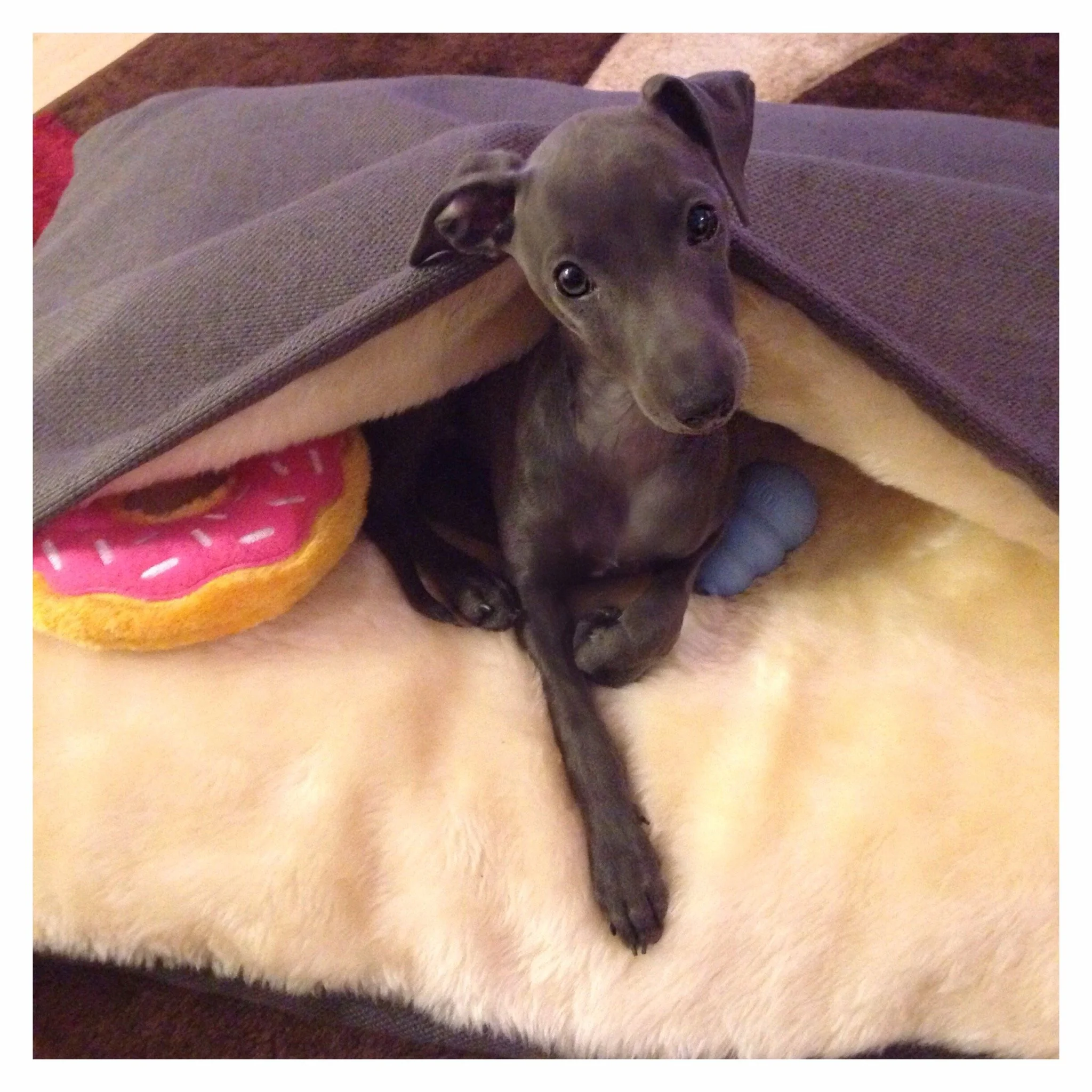
Keep Them Close at Night
Bailey slept in her crate, inside the puppy pen we had created for her. Our bedroom was only a few metres away, which we are sure reassured her. She had her own safe sleeping space, but she was not suddenly expected to feel comfortable at the other end of an unfamiliar house. An Italian Greyhound puppy who has always slept beside their mother and littermates may find the first nights alone unsettling. Keeping their crate or bed close to you initially can make the transition gentler. It also allows you to hear when they wake and may need to go outside.
Night-time toilet trips should be calm and uneventful: outside, quiet praise when they finish, and then back to bed. The aim is to meet their needs without accidentally turning two o’clock in the morning into playtime. A little restlessness is understandable, but we would not leave a genuinely distressed puppy to cry until they become exhausted. The crate should remain a place of safety, never somewhere they associate with fear or punishment. Being nearby during those first nights is not spoiling your puppy. You are helping them adjust to an enormous change.
Begin Alone Time Training Gently and Remain Realistic
Bailey always wanted to be with somebody. This will sound familiar to many Italian Greyhound owners: they are extraordinarily companionable dogs and often want to be involved in every part of family life.
It is still worth introducing very short periods of separation from the beginning. This might mean stepping to the other side of the room, moving briefly out of sight or allowing your puppy to settle in their pen while you remain elsewhere in the house. Begin with seconds rather than expecting minutes, return while they are calm and increase the time very gradually. The purpose is not to discover how long your puppy can endure being alone. It is to teach them, in manageable steps, that your absence is temporary and that you return.
We also want to be honest about our own experience. David worked tirelessly on this aspect of Bailey’s puppy training, yet she never became truly comfortable when left entirely alone. She would cry and howl, and this remained the case throughout most of her life. It was only when we welcomed our second Italian Greyhound, Joey, into our home—when Bailey was around 11 years old—that she was finally content for us to leave.
We would not suggest getting a second dog simply as a solution to separation-related distress; there is no guarantee that it will help. Bailey’s experience does, however, illustrate something important. Good training gives a puppy the best possible opportunity to cope, but it cannot make every dog feel the same way about solitude.
If your puppy becomes distressed rather than simply mildly unsettled, make the exercise easier rather than allowing the distress to escalate. For a dog who continues to cry, howl, pace or panic when left, speak to your vet and seek support from a suitably qualified behaviourist. Sometimes success means arranging your life and support around the dog in front of you, rather than forcing them to meet an expectation they find genuinely difficult.
Toilet Training and Setting Them Up to Succeed
Bailey was a superstar when it came to toilet training, but it was not simply good fortune. David worked consistently with her from the first day. His approach was to take Bailey outside more often than she was likely to need to go. This reduced the opportunity for accidents and created many more opportunities to reward the behaviour we wanted. Take a young puppy outside as soon as they wake, after eating, after play, before bed and whenever their behaviour suggests they may be looking for somewhere to go. In the early days, erring on the side of one extra trip outside is considerably easier than dealing with an avoidable accident indoors. Each time Bailey urinated, David calmly said, “wee wees”. For a bowel movement, the phrase was “hurry up”. Through repetition, she soon began to associate each phrase with the corresponding action.
The particular words do not matter. What matters is using them consistently, at the right moment, and following success with warm praise. Over time, a familiar cue can become extremely useful when you need your dog to go before a journey, bedtime or an especially wet winter walk. Accidents will still happen. Clean them thoroughly and carry on without anger or punishment. A puppy who has an accident has not been disobedient; they either did not yet understand what was expected or were not given the opportunity to get it right.
A phrase we heard during those early days has stayed with us and has since followed us into parenthood: set them up to succeed. Rather than waiting for Bailey to make a mistake and correcting her, we tried to arrange the circumstances in which the right choice was also the easiest one. It is a simple principle, but it shaped almost every successful part of her early training.
Create a Rhythm Rather Than a Rigid Timetable
A predictable daily rhythm helps a puppy begin to understand their new life. Meals, toilet trips, short periods of play and plenty of uninterrupted sleep do not have to happen at precisely the same minute each day, but a little consistency can be deeply reassuring. Keep their food and feeding routine familiar at first, following the information provided by their breeder. Their first week already contains enough change without introducing an unnecessary change of diet as well.
Training can also begin immediately, but it need not look like a formal lesson. Responding to their name, following you a few steps, settling in their bed and becoming comfortable with gentle handling are all forms of learning. Keep each interaction short, positive and appropriate for a puppy whose concentration may last only moments. Just as importantly, let them sleep. A bouncy puppy can appear to have limitless energy, but excitement and overtiredness can easily become confused. Their safe space gives them somewhere to switch off from the household and rest undisturbed.
Do Not Expect a Finished Dog After Seven Days
By the end of the first week, your puppy may still wake during the night, have the occasional accident, follow you from room to room or feel uncertain in new situations. None of this means you have done something wrong. Progress may look much smaller: choosing to enter their crate voluntarily, recognising the route to the garden, responding to their name or falling asleep without needing constant reassurance. These are the early signs that an unfamiliar place is becoming home.
Pay attention to the puppy in front of you. Some initial uncertainty is understandable, but persistent vomiting or diarrhoea, unusual lethargy, signs of pain, difficulty breathing, or a puppy who will not eat or drink should be discussed promptly with your vet. Your first week is not a test of how quickly you can produce a perfectly trained Italian Greyhound. It is the beginning of a relationship.
Keep their world manageable, be consistent, reward the behaviour you want and give them the closeness they need. You cannot control every accident, every interrupted night or every aspect of your puppy’s temperament. You can, however, create the conditions in which they have the greatest chance to feel safe and succeed.
That is more than enough for one week.